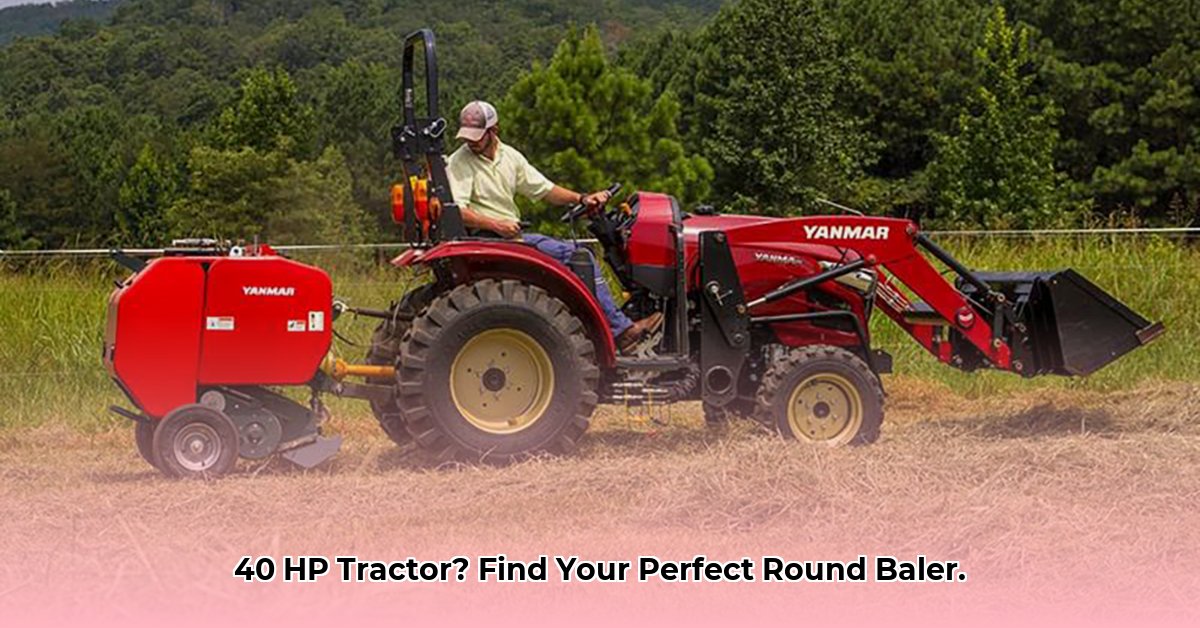
Choosing the right round baler for your 40 HP tractor is crucial for efficient and safe haymaking. This guide provides a step-by-step process to help you select the best baler for your specific needs and conditions. We'll cover key factors such as bale size, baler type, and terrain considerations, ensuring you make an informed decision. For more detailed information, check out this helpful baler guide.
Assessing Your Haying Operation: A Needs Analysis
Before selecting a baler, carefully assess your farm's requirements. This initial assessment forms the bedrock of your decision-making process.
- Annual Hay Production: How many acres do you typically bale each year? This directly impacts the capacity you need from your baler.
- Terrain: Is your land predominantly flat, gently rolling, or steeply hilly? Hillier terrain significantly limits baler choices.
- Hay Crop Density: Is your hay crop typically dense (e.g., alfalfa) or lighter (e.g., grasses)? Denser hay requires more power to bale.
Understanding these factors is crucial in determining the appropriate baler size and type for your 40 HP tractor. Ignoring this step could lead to inefficient haymaking and potentially damage your equipment.
Matching Your Tractor's Capabilities: Horsepower and Weight
While horsepower is important, your tractor's weight is equally crucial. A heavier tractor offers greater stability, essential for safe operation, especially on uneven terrain.
PTO Horsepower: Check your tractor's manual to confirm its Power Take-Off (PTO) horsepower rating. This indicates the power available to drive the baler.
Safe Weight Limits: Your tractor's manual also specifies safe weight limits for attached implements. Exceeding these limits can lead to instability and accidents. Remember, exceeding your tractor's capabilities increases the risk of equipment damage or injury.
A 40 HP tractor might be enough for smaller bales on flat ground, but hills or larger bales could quickly push it past its safe operating capacity.
Baler Types: Belt vs. Chain – Understanding the Differences
Two primary types of round balers exist:
Belt Balers: These generally require less horsepower and treat the hay more gently, resulting in a higher quality bale. They are often more suitable for 40 HP tractors, particularly if you prioritize hay quality over bale density.
Chain Balers: These produce denser bales, maximizing storage space, but demand more horsepower and are prone to greater wear and tear. Their greater power demands usually make them unsuitable for 40 HP tractors unless bale size is significantly reduced.
"For a 40 HP tractor, a belt baler is often a safer and more efficient choice," says Dr. Emily Carter, Agricultural Engineering Professor at Purdue University. "The lower power requirements minimize the risk of overloading the tractor and increase overall reliability."
Bale Size: Finding the Right Fit
Bale size directly impacts your tractor's workload. Larger bales (e.g., 4x5) demand significantly more power than smaller bales (e.g., 4x4 or even smaller).
- Consider Handling: Larger bales are more difficult to handle and transport. Evaluate your farm's storage and transport capabilities. Are your bale handling tools adequately equipped to handle the weight and size?
A 40 HP tractor is more reliably suited to smaller bales. Overloading risks are too high with larger bales.
Step-by-Step Guide to Round Baler Selection for Your 40 HP Tractor
This structured approach helps ensure a well-informed decision:
- Assess Your Operation: Analyze your annual hay production, terrain, and typical hay crop density (Step 1).
- Choose Baler Type: Select a belt baler over a chain baler for its lower horsepower requirements (Step 2).
- Determine Bale Size: Opt for a smaller bale size (e.g., 4x4) to minimize strain on your tractor (Step 3).
- Check Specifications: Carefully compare the baler's power requirements with your tractor's PTO horsepower and weight capacity (Step 4).
- Compare Models: Research various manufacturers and models, comparing reliability, parts availability, and pricing (Step 5).
- Consult Experts: Seek advice from experienced farmers or equipment dealers before making your purchase (Step 6).
Following these steps will significantly improve your chances of selecting a suitable baler.
Risk Assessment: A Balanced Approach
Balancing power, reliability, and maintenance is essential. The following table summarizes potential risks:
| Baler Type | Overloading Risk (40hp Tractor) | Parts Availability Risk | Maintenance Risk |
|---|---|---|---|
| Belt Baler (4x4) | Low | Medium | Low |
| Chain Baler (4x4) | Medium | Medium | Medium |
| Belt Baler (4x5) | Medium to High | Medium | Low to Medium |
| Chain Baler (4x5) | High | Medium | Medium to High |
Remember, used equipment can be cost-effective, but thorough inspection and verification of parts availability are crucial.
Prioritizing safety, alongside a practical assessment of your operation, is paramount for a successful hay season. Consultations with local experts are highly recommended.